.webp)



BLOG
Case Study
How to Hire International Employees Legally in 2026
March 1, 2026





More US companies are hiring internationally than ever before. Remote work opened the door, and now teams are realizing they don't need to limit their talent search to one country.
But here's where most guides miss the point: the question isn't whether you can hire internationally. You can, and it's completely legal. The real question is which hiring model fits your situation without exposing you to back taxes, misclassification penalties, or payroll headaches you didn't see coming.
The compliance risk is real. Between 10% and 30% of employers currently misclassify workers, according to the National Employment Law Project. Getting it wrong doesn't just mean paperwork. It means retroactive tax liability, fines, and legal claims in the employee's home country.
This guide cuts through the noise. It covers the four ways US companies hire internationally, what each one actually costs in time and risk, and how to pick the right path for where your company is right now.
Here's what we'll cover:
TL;DR: US companies can legally hire international employees in three ways: as contractors, through an Employer of Record (EOR), or by setting up a local legal entity. Most growing teams use an EOR or a partner like Athyna— it handles local contracts, payroll, and compliance without requiring you to incorporate abroad.
Yes. US companies can legally hire people in other countries without setting up a foreign office or obtaining special government approval. The legal structure you use determines how that relationship is governed, not whether it's permitted.
The single most important decision you'll make is whether to hire someone as an employee or an independent contractor. That choice determines your tax obligations, compliance requirements, and legal exposure in the worker's home country.
An employee works under your direction, they follow your schedule, use your tools, report to your managers, and are integrated into your team. A contractor operates independently, controls their own methods, and typically serves multiple clients.
The problem is that many companies default to contractor agreements because they're faster to set up. But the contract doesn't override local employment law. If the actual working relationship looks like employment, most countries will treat it as employment regardless of what the paperwork says.
The risk in plain terms: Misclassification can trigger back taxes, unpaid social insurance contributions, and legal claims that reach back years. In California alone, fines for misclassification run up to $25,000 per violation. Globally, enforcement has tightened considerably since 2024.
When you structure the relationship correctly from the start, international hiring is straightforward. The section below explains the four models that make it work.
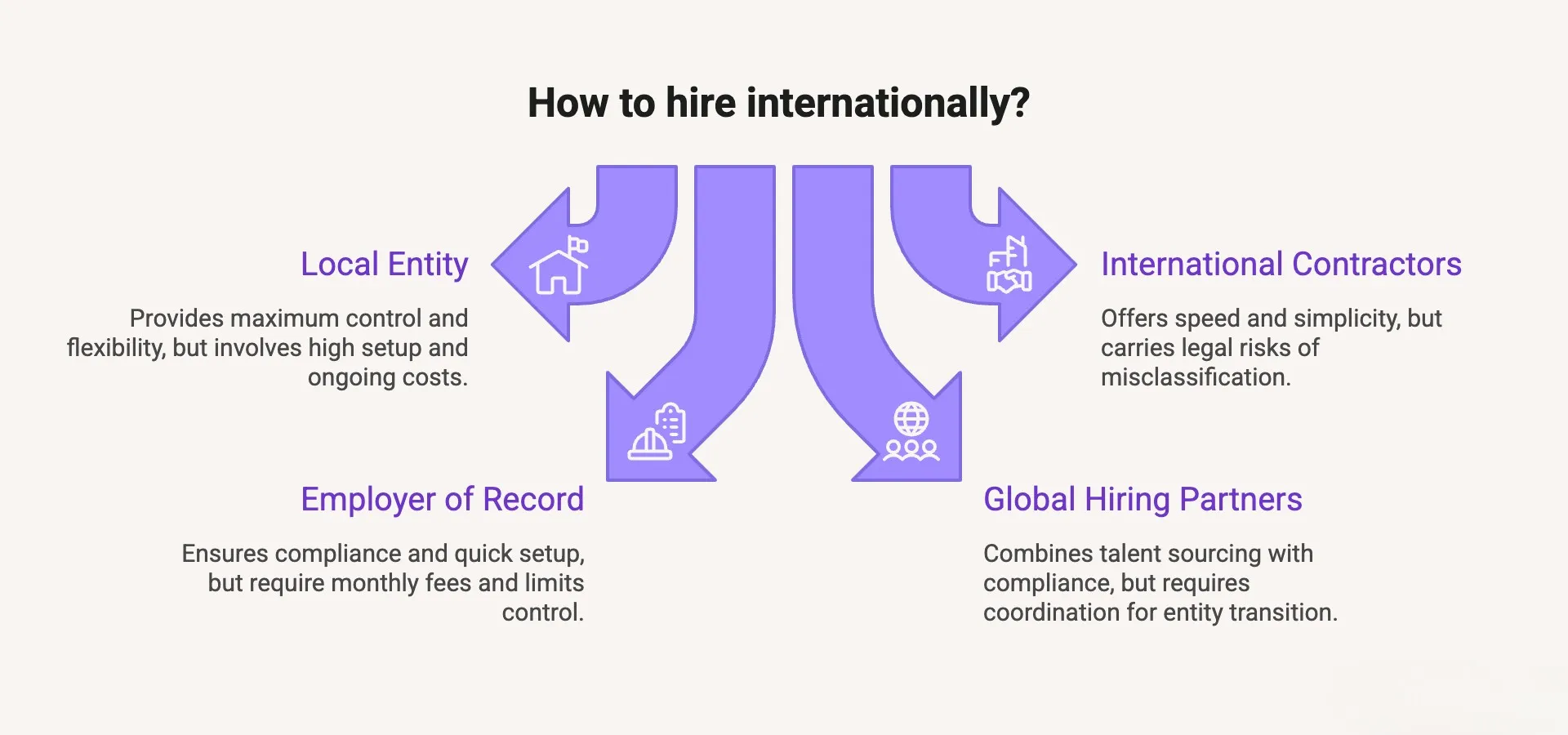
US companies have three main options for hiring internationally: independent contractor agreements, Employer of Record (EOR) services, and direct entity setup. The right choice depends on how many people you're hiring, in which countries, and whether you need them classified as employees or contractors.
You establish a legal subsidiary, branch office, or equivalent in the country where you're hiring. This gives you full control over employment terms, benefit design, IP ownership, and the entire employment relationship.
When it makes sense: Companies hiring 10 or more people in a single country, or those planning a long-term market presence with a need for direct employer status.
The real cost: Entity setup runs anywhere from $15,000 to $50,000+ depending on the country, and takes three to six months before you can make a single hire. After that, you're paying ongoing costs for local accounting, legal compliance, and tax filing year over year. You get maximum control, but the price is both time and overhead.
Most companies try this first because it's the fastest path. You send invoices, they handle their own taxes, and you can onboard someone in days with minimal paperwork.
When it actually works: True project-based assignments with defined deliverables, workers who serve multiple clients, and arrangements where you don't control their methods or schedule.
Where it breaks down: If your "contractor" works exclusively for you, follows your schedule, uses your tools, and reports to your managers daily, most countries will classify that relationship as employment. The contractor label doesn't change the legal reality. This is the model with the highest compliance risk in 2026, as governments globally have increased enforcement of misclassification rules.
An EOR becomes the legal employer in the country where you're hiring. They handle contracts, payroll, taxes, and compliance. You direct the work; they manage the paperwork and legal obligations.
Why this model has grown: According to the Atlas HXM Global Atlas Report 2026, 54% of organizations now use or plan to use an EOR, surpassing both fully owned entities (45%) and independent contractors (34%). In the US specifically, openness to EOR rises to 59%. The top reasons: avoiding entity setup costs (44%), providing a more employee-like experience (41%), and maintaining flexibility to scale (40%).
The tradeoff: Monthly fees per employee add up, typically $200 to $800+, depending on the country and provider. You're also working within the EOR's contract terms and benefit structures, which limit some flexibility on compensation design.
A global hiring partner combines talent sourcing with the compliance infrastructure already built in. They handle vetting, hiring, contracts, payroll, and local compliance while the employee works directly on your team day to day.
The practical difference from an EOR: You're not sourcing separately and then plugging into a compliance layer. The partner handles both, which compresses the time from "we need someone" to "they start Monday."
The main reason is cost without compromise. A senior software engineer in LATAM costs $40–70k/year; the same role in the US runs $130–180k. That gap funds another two hires, or extends your runway by months. Beyond cost, companies are hiring globally because top candidates are no longer waiting in local job markets — distributed teams now outperform co-located ones on retention and output.
The core advantages that keep coming up:
The companies moving fastest on this aren't treating international hiring as a workaround. They're treating it as a deliberate talent strategy with a compliance layer built in from day one.
When US companies evaluate international hiring regions, Latin America keeps rising to the top for reasons that go beyond geography.
Most international hiring creates a collaboration tax: async delays, late-night standups, and feedback loops that stretch deadlines. LATAM sits one to three hours from US time zones, depending on the country. Real-time collaboration happens naturally. You're not coordinating across a 12-hour gap.
Latin America has over 2 million tech professionals, with strong concentrations in Argentina, Mexico, Colombia, and Brazil. English proficiency in professional roles is common, and technical skills in software development, design, marketing, and operations consistently match US expectations.
US companies typically save 50–70% on costs when hiring in LATAM compared to equivalent US salaries, without sacrificing output quality. A senior developer in Argentina or Colombia brings the same technical depth as one in San Francisco at a fraction of the cost. That's not a rounding error; it's a structural advantage that compounds across a growing team.
Communication styles and professional expectations in LATAM align closely with US business culture. Many LATAM professionals have direct experience working with US companies and understand American business norms. That cultural alignment shortens onboarding, reduces miscommunication, and improves retention compared to regions with larger cultural gaps.
LATAM's business-friendly employment laws, combined with the time zone and cultural alignment, mean fewer complications than hiring in regions with more restrictive labor regulations. The compliance work is still real, but the operational integration is significantly smoother.
For US companies building distributed teams, LATAM isn't just a cost play. It's the region that checks the most boxes at once.
Once you've picked a model, the actual hiring process follows a familiar path:
The biggest time sink in this process is usually steps two and three. Sourcing takes weeks when done manually, and compliance setup can add more weeks on top of that.
That's the problem Athyna is built to solve. We combine vetted talent sourcing with built-in compliance infrastructure, so you're not running two parallel processes. Employment contracts, local payroll, tax withholding, and benefits administration are handled in each country. You direct the work; we handle the legal layer.
Most clients meet qualified candidates within four days. Employment typically starts within two weeks. No entity setup, no EOR subscriptions to manage separately, and no sorting through hundreds of unvetted applications.
If you're evaluating how to build an international team without the compliance risk, talk to our team and we'll walk you through what it looks like for your specific situation.
.webp)
Digital Strategist at Athyna, aka the SEO girl.
.svg)
Yes. US companies can legally hire employees in other countries using several structures: setting up a local entity, using an Employer of Record, or working with global hiring platforms. The key is structuring the relationship correctly under the employee's local law.
The best approach depends on your hiring volume and timeline. For faster hiring with proper compliance, working with a global hiring partner like Athyna provides vetted talent, handles legal infrastructure, and gets you from search to hire in days instead of months.
The timeline depends on your method. Contractor relationships can start in days but carry legal risk. Entity setup takes 3-6 months. EORs typically require 2-4 weeks. Global hiring platforms like Athyna can have candidates ready in 4 days, with employment starting in 2 weeks.
Treating employees as contractors is the biggest risk. This opens you up to back taxes, penalties, and legal claims. Incorrect tax withholding and employment contracts that don't comply with local law. Most of these issues come from companies using contractor setups when the relationship is legally employment.
No. International remote workers remain in their home country and don't need US visas. They work remotely from their location. Visas only become relevant if you're bringing them to the US for work, which is a different scenario entirely.
Payroll must comply with each country's tax and social security requirements. This includes proper withholding calculations, mandatory benefits, and timely remittance to local authorities. Most companies use specialized international payroll providers, EORs, or global hiring platforms rather than managing it directly.